Last Updated on 17/03/2026
The City of London’s relationship with heraldry is almost as old as the English practice of granting armorial bearings – coats of arms, crests and badges. Throughout history, many Freemen and Liverymen have borne arms, and the tradition continues today. By long‑standing custom, the City’s Sheriffs are usually armigerous (that is, granted arms), and by extension so is the Lord Mayor.
Note:
Heraldic convention traditionally treats women less favourably in matters of entitlement, display and inheritance. In 2023, the City’s elected Sheriffs decided to postpone petitioning for personal arms until the Kings of Arms reform heraldic practice to ensure equality between the sexes. This decision was made with the knowledge of the Court of Aldermen. At least one Company without Livery has likewise chosen to delay seeking corporate arms until such reform is achieved.
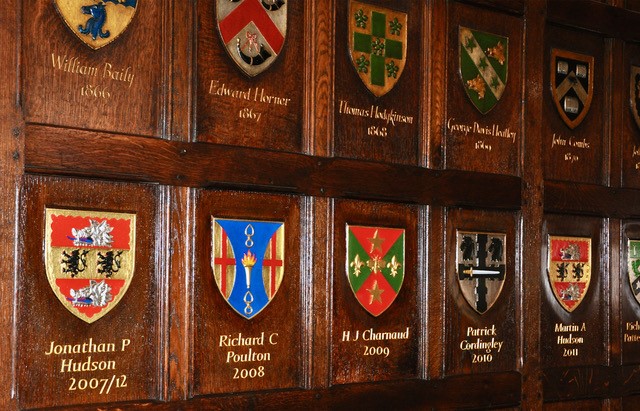
Various shields of Past Masters in Ironmongers’ Hall (© Paul D Jagger)
Grants of Arms
Arms are granted by the Crown, under the authority of the Earl Marshal, to living individuals whose legitimate heirs may inherit them and to legal persons such as companies, universities, professional bodies and learned societies. In essence, any entity capable of owning property, entering contracts, or taking legal action may be granted arms. Arms have never been granted to surnames, and the murky online trade in so‑called “family crests” has about as much legitimacy as the practice of selling spare bricks from the Berlin Wall.
The City of London’s own coat of arms appears throughout the Square Mile in stained glass, on buildings, on street furniture, and even on this website. They were first devised by Lord Mayor Sir William Walworth (Citizen & Fishmonger) in April 1381. A frequently repeated myth claims that the sword in the canton represents the weapon Sir William used to kill Wat Tyler, leader of the Peasants’ Revolt. In fact, that encounter took place in June 1381, three months after the first recorded use of the City’s arms. Sir William may well have dined out on that convenient tale for some time. The sword actually represents the sword of St Paul, the City’s patron saint.
The College of Arms
The home of English heraldry is the College of Arms, located in the Square Mile since 1555. The current building on Queen Victoria Street is a post Great Fire reconstruction. Although called a “college,” it enrols no students and confers no degrees. Instead, the thirteen Officers of Arms who constitute the College are responsible for heraldic matters across England, Wales, Northern Ireland, the Crown Dependencies (Jersey, Guernsey and the Isle of Man), and the Commonwealth Realms; except Canada, which has its own heraldic authority. Scotland, likewise, maintains its own long‑established jurisdiction: the Court of the Lord Lyon, which predates the union of the Crowns.
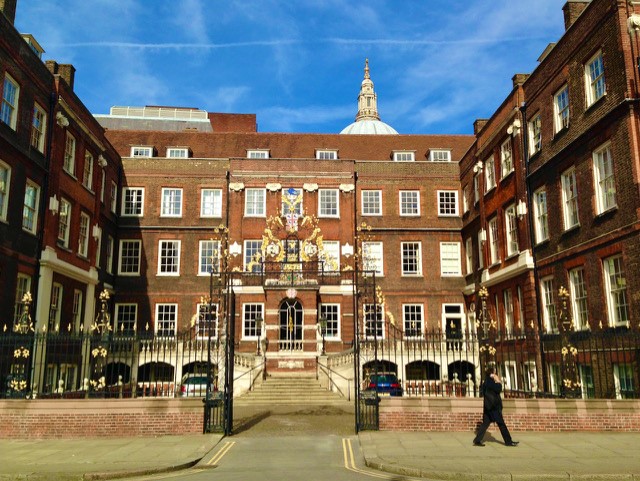
The College of Arms (© Paul D Jagger)
Perhaps unsurprisingly, there is a long history of heralds joining the ranks of the Livery and serving on Common Council, right up to the present day.
All of the City’s Livery Companies possess their own coats of arms, proudly displayed in Guildhall and in many other locations across the Square Mile. Those Companies fortunate enough to have a hall will almost invariably exhibit heraldry within it, whether the arms of Past Masters or of Liverymen who have held the office of Lord Mayor. Particularly fine examples of this heraldic tradition can be seen in Armourers’ Hall and Ironmongers’ Hall.
It is easy to dismiss heraldry as arcane, perhaps even moribund, but nothing could be further from the truth. Interest in heraldry is closely tied to the study of genealogy—one of the most commercially successful sectors of the modern internet. The demand for personal, inheritable symbols of identity and kinship remains exceptionally strong.
The art and science of heraldry opens the door to a wealth of wider study: architecture, sculpture, monuments, silverware, stained glass, manuscript illumination, and so much more. Heraldry has often been described as “the shorthand of history”—and rightly so. In concise visual form, it preserves centuries of lineage, allegiance and story.
Freemen and Liverymen who wish to explore heraldry further may like to join the Heraldry Society, a registered charity whose Vice Presidents include three ex‑officio Masters: the Scriveners, Glaziers and Painter‑Stainers. The Society offers free public lectures, publishes a quarterly magazine and an annual journal, runs several competitions, administers a corporate heraldry award (past winners include the Fan Makers and the Information Technologists), and provides a structured programme of examinations. Membership is open to all, and no prior knowledge of heraldry is required.
There are two excellent books on Livery Company heraldry. The first, affectionately known as Bromley & Child, is long out of print and covers the period 1439–1957:
- The Armorial Bearings of the Guilds of London
John Bromley & Heather Child (1960), Frederick Warne & Co.
The second, written by Past Master Richard Goddard (Waterman), covers the period 1957–2018 and is readily available:
- The Heraldry of the Livery Companies of the City of London since 1954
Richard Goddard (2018), ISBN: 978‑0‑99346‑803‑2
Freemen and Liverymen interested in petitioning for armorial bearings may also find it helpful to attend one of the twice‑yearly Grant of Arms Workshops, held in the City or online. These can be found by searching eventbrite.co.uk for “Grant of Arms”.
Contact
If you would like advice or help from the heralds, you can contact the College of Arms using the details below:
Officer in Waiting
College of Arms
130 Queen Victoria Street
London
EC4V 4BT
United Kingdom
email: enquiries@college-of-arms.gov.uk
tel: 020 7248 2762